2026 GMC Sierra 1500 vs. Sierra 2500HD: Which Truck Is Right for You?
If you're shopping for a new GMC Sierra around Peru, Illinois, there's one question that decides everything else: do you actually need a heavy-duty truck, or will a Sierra 1500 do everything you ask of it?
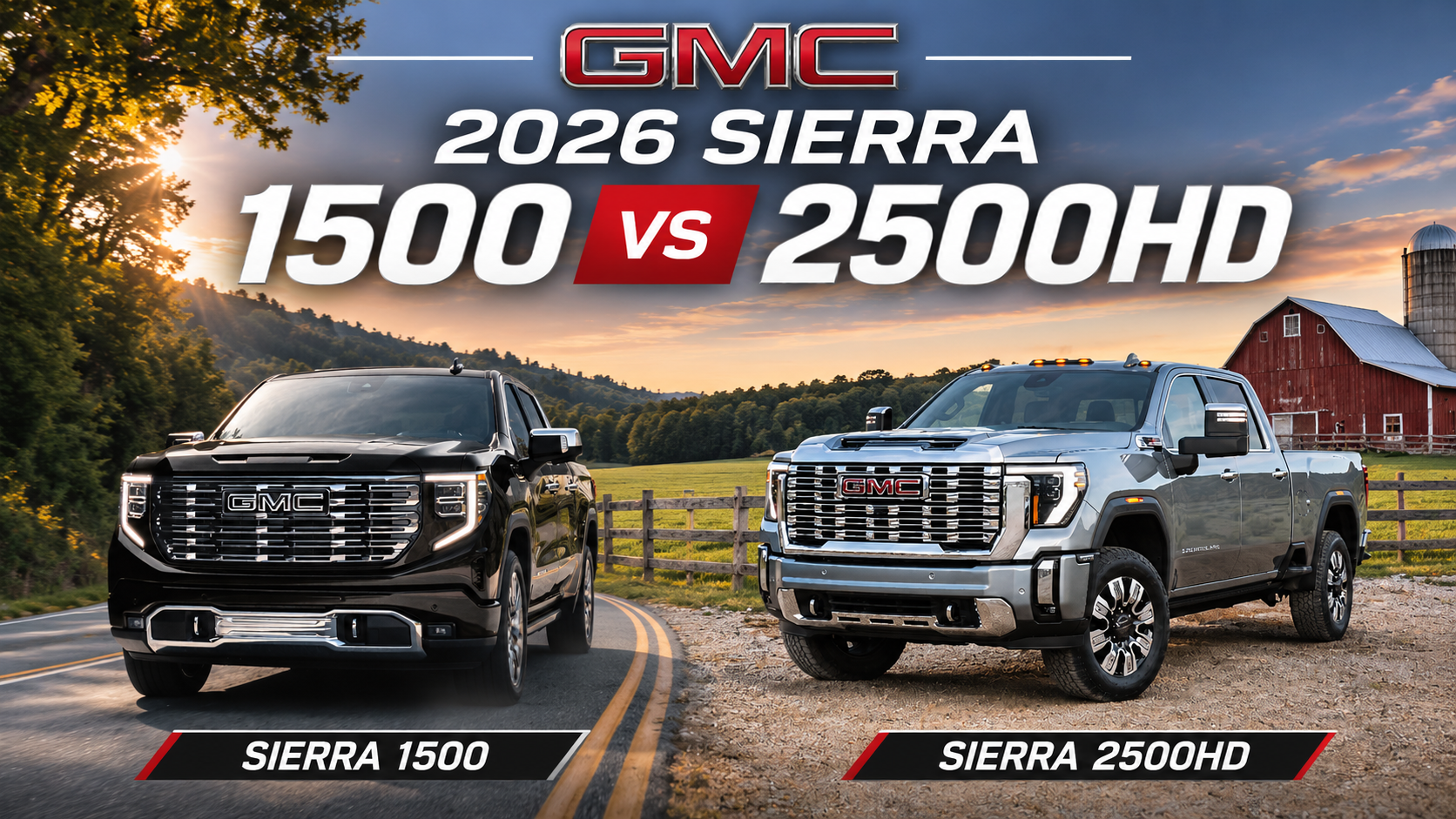
Here's the short answer. The Sierra 1500 is the better choice for most buyers — daily commuting, family hauling, a boat or a moderate travel trailer, and pulling into a parking space in downtown Ottawa without a three-point turn. The Sierra 2500HD is the right choice when the trailer, the load, or the job site sets the schedule — heavier campers, equipment trailers, ag use, and anything that involves fifth-wheel or gooseneck towing on a regular basis. The HD isn't "more truck" in a way that automatically makes it better; it's a different tool built for heavier work, with real trade-offs in ride, fuel use, and cost.
Side-by-Side: 2026 Sierra 1500 vs. Sierra 2500HD
Figures are per GMC's 2026 model information. Maximum available ratings are the best figure achieved by one specific, properly equipped configuration — not the capability of every Sierra.
Why Configuration Determines Everything
GMC builds the Sierra in dozens of combinations of cab, box length, drivetrain, engine, axle ratio, and equipment — and a truck's ratings are set by that exact build. So a maximum published anywhere for the model isn't the rating for the truck on the lot. Two Sierras with the same cab can still differ, because engine, drivetrain, and trim equipment all affect the number. Adding weight — a sunroof, premium audio, a heavy hitch, a bed liner — reduces available payload.
Cab and Bed: A Difference You'll Feel Daily
The two trucks don't offer the same body styles:
The Sierra 1500 offers Regular Cab, Double Cab, and Crew Cab. A long box is available with the Regular Cab, while the Crew Cab comes in short and standard box configurations, and the Double Cab in a standard box.
The Sierra 2500HD offers Regular Cab, Double Cab, and Crew Cab, with standard and long boxes on the Double and Crew Cabs and a long box on the Regular Cab. There is no short box on the 2500HD.
Practical read: if a crew cab with a short box — the easiest of the two to park and garage — is what you want, that configuration only exists on the 1500. If you need a crew cab with a full-length bed, that's the 2500HD.
Towing and Payload: The Real Difference
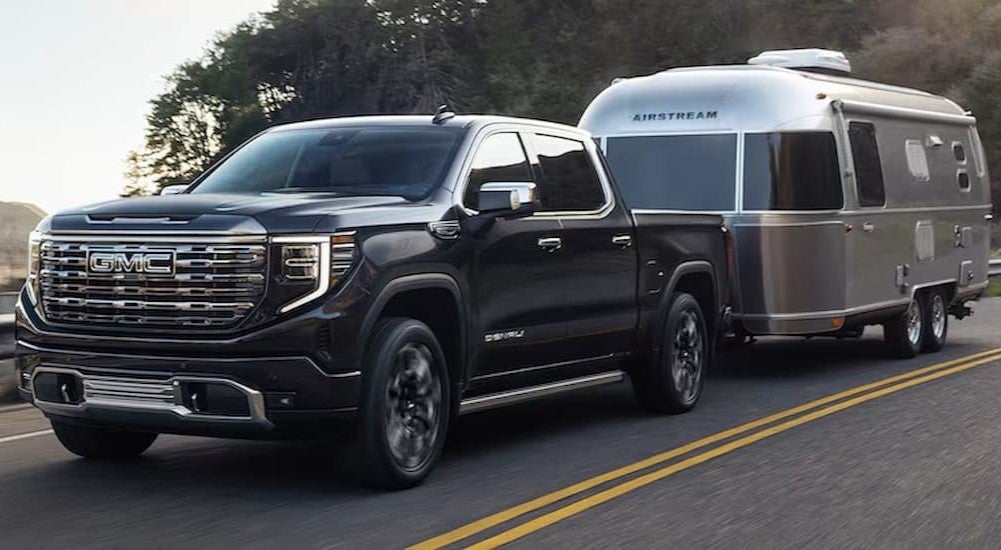
Conventional trailer towing — a receiver-hitch setup with a hitch ball — is the standard approach for boats, utility trailers, small travel trailers, and the equipment most Illinois Valley drivers tow. Both trucks are built for it; the 1500's maximum available conventional towing rating is 13,300 lbs, and the 2500HD's is 20,000 lbs, each properly equipped.
Fifth-wheel and gooseneck towing — where the hitch sits in the bed over the rear axle — is where heavy-duty trucks live. The 2500HD's maximum available fifth-wheel/gooseneck rating is 22,390 lbs, properly equipped. That rating depends heavily on the truck's payload, because the trailer's pin weight comes straight out of it. If fifth-wheel or gooseneck towing is your plan, the Sierra 2500HD is the natural starting point — and confirm the specific trailer's pin weight against the truck's payload rating before you commit.
The Payload Math Most Buyers Skip
Payload is what your truck can carry, and it includes far more than the trailer. The 2500HD's maximum available payload is 4,049 lbs, properly equipped. Available payload gets consumed by, in order:
You and your passengers.
Everything in the cab and bed — tools, coolers, firewood, dog crates, generators.
Trailer tongue weight (conventional towing) or pin weight (fifth-wheel/gooseneck). Tongue weight is roughly a tenth of a loaded trailer's weight on many setups; pin weight tends to run higher as a share of trailer weight.
So the question isn't just "can it pull this?" It's "can it carry this — with my family, my gear, and my hitch, on a full tank?" The place where buyers get surprised is the family of five towing a camper with the bed full: everything competes for the same payload number. If you're near the edge of a 1500's limits with your typical load, that's your signal to look at the 2500HD — not because the trailer is extreme, but because you have no margin left.
Engines: Gasoline vs. Diesel
Sierra 1500 gives you four choices: the TurboMax 2.7L (310 hp, 430 lb-ft), the 5.3L V8 (355 hp, 383 lb-ft), the 6.2L V8 (420 hp, 460 lb-ft), and the 3.0L Duramax diesel (305 hp, 495 lb-ft).
Sierra 2500HD gives you two: the 6.6L gas V8 (401 hp, 464 lb-ft) and the 6.6L Duramax diesel V8 (470 hp, 975 lb-ft).
How to think about it:
Gasoline engines generally cost less upfront, are simple to own, and suit lighter, less frequent towing and everyday driving.
Diesel in the 2500HD is the choice for heavy, frequent towing — owners tend to value the low-end pulling power and steadier behavior under a loaded trailer.
Diesel in the 1500 is a different proposition. The 3.0L Duramax appeals to buyers who want strong low-end torque in a light-duty truck and the highway efficiency a diesel can deliver on longer drives — a meaningful draw if your week includes steady runs on I-80 or I-39 rather than short hops around town.
Two honest cautions:
Don't buy diesel for fuel savings alone. The upfront premium and the cost of diesel and its maintenance usually mean the math only works if you genuinely work the truck hard or cover a lot of highway miles.
Don't assume the diesel is automatically the highest-rated tow configuration. Ratings are set by the complete build, not the engine badge alone — as the table shows, the 1500's maximum available conventional towing rating belongs to one properly equipped configuration, not to every engine choice.
Comfort, Maneuverability, and Everyday Livability
Sierra 1500. This is the truck you can drive every day without thinking about it. It's easier to maneuver in a crowded lot, easier to fit in a garage, and tuned to be comfortable when it's empty — which is how it spends most of its life.
Sierra 2500HD. Everything about it is engineered around carrying and pulling load. The payoff is capability; the trade-off is a firmer unladen ride, more size to manage, and a wider turning circle. If you drive the HD back-to-back with the 1500, you'll feel the difference in the first parking lot.
Neither is "better." But if your truck is 90% commuter and 10% tower, the 1500 will make you happier the other 90% of the time.
Interior and Technology
Both lineups offer modern infotainment, connectivity, and driver-assistance content, with the richest materials and largest feature sets concentrated in the higher trims. On the 2500HD, you can generally get the same premium interior experience as the 1500, since the HD shares the Sierra's cabin approach.
What differs is availability by trim and configuration, not one truck being more modern than the other. Tell us which features matter — towing cameras, trailer integration, heated seats, a specific screen size — and we'll tell you which trims and builds carry them.
Long-Term Ownership Considerations
Three things to weigh beyond the sticker:
Purchase price. A comparable heavy-duty build costs more than a light-duty one. Some of that premium is worth it only if you'll use the capability.
Fuel costs. Actual operating costs depend on engine choice, driving conditions, fuel prices, and how the truck is used. Heavier trucks with larger engines tend to consume more fuel, and over several years that difference can add up — but your own mix of towing, highway miles, and short local trips matters more than any general rule. If a lot of your mileage is highway, a light-duty diesel like the 1500's 3.0L Duramax can be a sensible fit.
Maintenance and wear. Heavy-duty trucks under heavy use consume tires, brakes, and service more quickly, and diesel adds its own routine requirements. These costs are use-dependent, not fixed: if you tow rarely, you may be paying HD ownership costs for light-duty work.
Choosing a truck that cannot comfortably accommodate your regular towing and hauling needs can lead to frustration, reduced flexibility, and the need to upgrade sooner than expected. Matching the truck to the work you actually do — rather than to the work you might do someday — is what keeps ownership straightforward.
Who Should Buy Which
The Sierra 1500 fits you if you are:
Commuting into LaSalle, Ottawa, or Princeton, with a truck that doubles as family transport.
Towing a boat to the Illinois River or a local lake, or a modest travel trailer a few weekends a year.
Hauling mulch, lumber, or a riding mower — real truck work, but not at the ceiling.
Wanting the easier, more comfortable truck to live with daily.
The Sierra 2500HD fits you if you are:
A contractor or business owner whose truck is a work asset and whose trailer is loaded most days.
Farming or hauling ag loads, livestock, or equipment around Bureau County and the Illinois Valley.
Towing a larger travel trailer, a fifth-wheel camper, or heavy equipment regularly.
Routinely at your payload limit with passengers and gear aboard.
How to Choose Your Configuration
Walk in with these five answers and the decision gets straightforward:
What's the loaded trailer weight — actual weight, not the brochure dry weight?
What's the tongue or pin weight, and how does it compare to the truck's payload label?
Who and what rides along — passengers, tools, gear, and their total weight?
How often do you tow, and how far?
What's your daily-driving reality — parking, garage height, tight job sites?
Bring those numbers, and we can compare actual configurations rather than guessing.
See the Sierras on the Ground
You can browse new GMC Sierra inventory at Jeff Perry Buick GMC here: Search New GMC Sierra Inventory.
On any truck you're considering, review both the vehicle's door-jamb weight and payload labels and GMC's vehicle-specific trailering information for that exact build. The door label tells you what the truck can carry; it does not by itself establish what it can tow. Only GMC's model- and configuration-specific trailering information gives you the applicable towing ratings for that truck — which is why the two go together.
The Bottom Line
For most Peru and Illinois Valley truck buyers — commuters, families, and weekend towers — the 2026 GMC Sierra 1500 is the smarter, more livable choice, and it will handle a surprising amount of real work. Step up to the 2026 GMC Sierra 2500HD when your trailer, your payload, or your paycheck depends on the truck being able to do more than that, every single day.
Still not sure which Sierra is right for you? Visit Jeff Perry Buick GMC at 1421 37th St in Peru, Illinois, or call us at (815) 223-0034. Tell us about your trailer, your typical load, and how you use your truck every day. We'll help you compare available Sierra configurations and including whether you need a heavy-duty truck at all..